


We Are Nobody’s Soldier

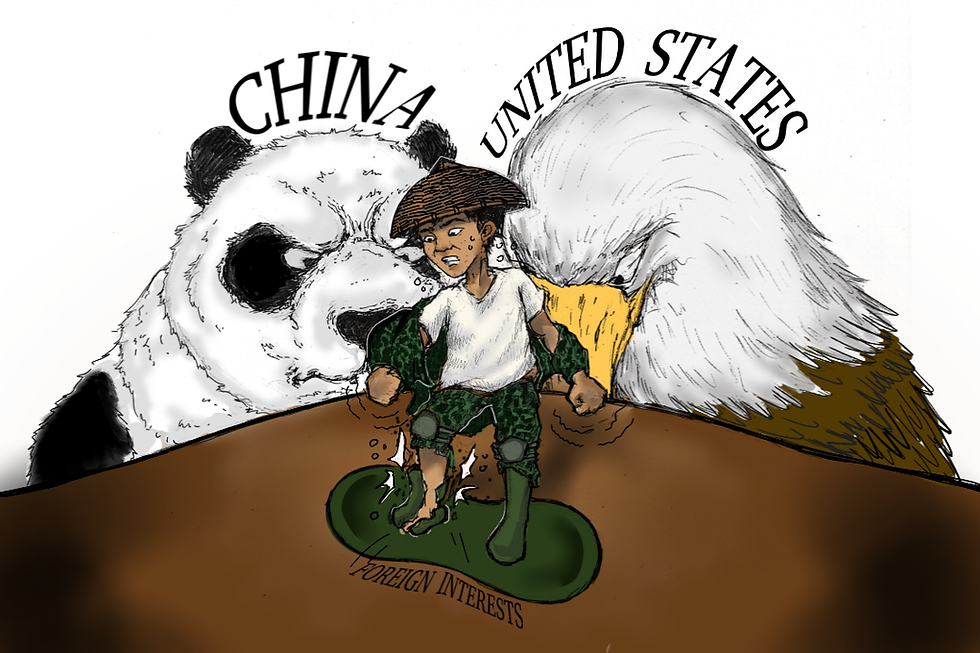
From Spanish galleons to American warships, the Philippines has long been a strategic outpost for powers seeking influence in the Pacific. Today, the struggle has returned, holding a different form—this time it's not just colonial flags planted on our shores, but through warships, military bases, and territorial claims.China continues to challenge Philippine sovereignty in the West Philippine Sea, while the United States deepens its military presence through long-standing defense agreements with Manila. Between these superpowers lies a dangerous possibility: that the Philippines could once again become a playground for forces far larger than itself. The question now is whether Filipinos can face this moment as a united nation—or will we remain divided while others determine the fate not just of our seas, but also our homeland?
In February 1995, China seized Panganiban Reef—a tiny atoll lying just 200 kilometers from Palawan and well inside Philippine-claimed waters. According to the Center for Strategic and International Studies, Filipinos woke up on February 8, discovering a Chinese flag flying over the reef, with eight Chinese ships, some armed, already stationed there. China then quietly began constructing structures and planting markers, effectively turning a disputed shoal within the Philippines’ EEZ into a Chinese outpost overnight. This was no accidental fishing shelter; it was a deliberate, unannounced grab of sovereign territory deep within the Philippines’ exclusive economic zone.
The move stripped Filipino fishermen of access, violated international law on maritime claims, and signaled China’s willingness to use force to expand its control in the Spratlys. For a militarily weak Philippines, it was a humiliating act of aggression that exposed the country’s vulnerability and set the stage for decades of escalating harassment in the West Philippine Sea that hasn't stopped until today.
In 2025 alone, the Philippine Coast Guard (PCG) recorded 64 illegal, coercive, aggressive, and deceptive actions by the Chinese state and their vessels—risky close approaches, tailing, water-cannon attacks, collisions, and live-fire exercises, according to news reports by Inquirer. Last December, Chinese Coast Guard and armed Chinese fishing boats used water cannons and blocked our boats near Escoda Shoal, injuring three Filipino fishermen and damaging their boats, the PCG said. In February 2026, according to a report by ABS-CBN, the Philippine Navy counted 62 Chinese vessels all operating at the same time in the West Philippine Sea. Meanwhile, Chinese maritime militia deployments across the broader South China Sea reached a record daily average of 241 vessels in 2025, according to monitoring by the Asia Maritime Transparency Initiative. These are not isolated fishing disputes. They are a sustained gray-zone campaign—a strategy of repeated low-level pressure and harassment that are not enough to declare an open war—to normalize control over waters that the 2016 Permanent Court of Arbitration ruling declared part of the Philippines’ exclusive economic zone.
Adding to this challenge is the growing presence of U.S. forces in the Philippines, through the Enhanced Defense Cooperation Agreement (EDCA)—a bilateral agreement between the US and the Philippines where U.S. troops rotate through Philippine bases and place their own equipment—signaling Washington’s commitment to Manila. This strengthens deterrence, but it also reshapes the Philippines’ strategic landscape. If Beijing were to attempt to take over Taiwan and Washington were to defend them by using military force, Chinese advisers might view U.S. infrastructures in the region—including military troops stationed abroad and bases in the Philippines—as legitimate targets. Similar logic applies to U.S. bases in Guam, Okinawa, and South Korea where hosting foreign troops makes these places both strategically important and vulnerable to attack. China has thousands of ballistic and cruise missiles that can reach much of the Western Pacific, meaning airfields, ports, and staging sites could be hit to weaken U.S. operations. Deterring this means stopping adversaries from freely using their bases, which puts Philippine territory within the chessboard of the rivalry between these two geopolitical giants. Along with China’s ongoing gray-zone tactics in the West Philippine Sea, hosting foreign troops could turn the Philippines from a bystander into a frontline player—a shield that also doubles as a spotlight.
While all of these are happening, our real weakness continues to lie within. Elite dominance, structural inequality, and social media polarization continue to divide us at a time when unity is most needed. At a time when Filipinos would much rather argue about the growing rift between the Marcos-Duterte administration—taking sides on who is the better one between the two—and the appearance of troll farms constantly trying to disinform and divide us, we risk becoming not defenders of our own territory, but as pawns in a struggle decided by others. While the West Philippine Sea is under siege, we spend more time arguing online than looking at the larger threat looming over our sea.
This is why national unity is inseparable from strategic strength. Political cohesion, social solidarity, and clear public support for national defense allow the Philippines to act decisively, negotiate from a position of strength, and resist coercion. Countries with internal fractures are easier to manipulate—whether through economic pressure or political influence. A united citizenry is as crucial to defense as modern ships, aircraft, or missiles. At the same time, alliances alone cannot carry the full burden of protecting our sovereignty. The Philippines must also invest in independent defense: modernizing the navy, air force, and coast guard, improving maritime domain awareness, and building credible deterrence at home. Only a capable and self-reliant military, paired with a united citizenry, can ensure that we are not wholly dependent on foreign powers for our security, and that our choices reflect national interest first.
Strategically, this does not mean abandoning alliances or neutrality. The Philippines should maintain cooperative relationships with partners like the United States and regional neighbors, while simultaneously investing in independent defense. Diplomacy, multilateral engagement through ASEAN, and credible deterrence at home create a balance: the Philippines can benefit from partnerships without becoming a pawn in someone else’s geopolitical game.
History has shown that when Filipinos are divided, external powers take advantage—whether it was colonial Spain, U.S. rule, imperial Japan, or today’s geopolitical giants. If we continue down this path, no legal ruling, no military alliance, and no international sympathy will protect our sovereignty.
But beyond strategy, this is about what we choose to protect. When they come knocking at our door, we can answer only as one.
The West Philippine Sea and our archipelago are ours. They are the cradle of our fishermen, the horizon of the children, and the mirror of our history. If we continue to fight over petty divides, we hand that sea, and our future, to others. But if we can rise beyond the noise of the people who try to divide us, beyond the fractures that have long splintered us, we can reclaim what is ours—as an unyielding force that stands as one.
Then, and only then, will the Philippines be nobody’s soldier.
Article: Rikki Jan Ebias
Cartoon: Sherlyn Zabate


Comments