


Hashtag Earth Day: A Trend That Ends Tomorrow

Every April 22, Earth Day arrives like a visitor everyone pretends to prepare for.
Schools are suddenly gripped by “green fever,” asking each student to design a ‘Save the Planet’ poster that typically ends with a drawing of a pair of hands holding the Earth. Then, teachers proudly hang posters along the corridors. Government offices are posting hashtags. Social media is blowing up with timelines filled with people posting their photos holding seedlings that may or may not survive a week, captioning “Save Mother Earth.”
For one day, the world looks like it remembers.
Earth Day is celebrated worldwide with speeches about saving oceans, forests, the atmosphere, and conserving energy. It is a day that brings citizens and activists around the world together to raise awareness and promote proactive responses to environmental concerns such as global warming and protecting natural resources for future generations.
Yet for many, it’s just an event—not a habit.
And events are easy.
It’s easy to post nature quotes. Then the next day, to order milk tea in disposable cups, plastic lids, and plastic straws.
It’s easy to share Earth Day posts online, then throw candy wrappers outside the jeepney window or out in the streets just because they’re small, forgetting that millions of small pieces of trash become mountains.
It’s easy to share “Save the ocean” captions. Then, go to the beach on holidays, shoot Instagram-worthy sunset pictures, while plastic bottles and styrofoam are left behind on the sand.
It's easy to talk about how to protect wildlife, yet every day people receive online shopping parcels, wrapped in bubble wrap and layers of tape, justified by the simple excuse of ‘deserve ko naman.’
People can keep their homes spotless yet treat the streets like their own temporary dumping ground, believing that someone else will clean what they refuse to handle.
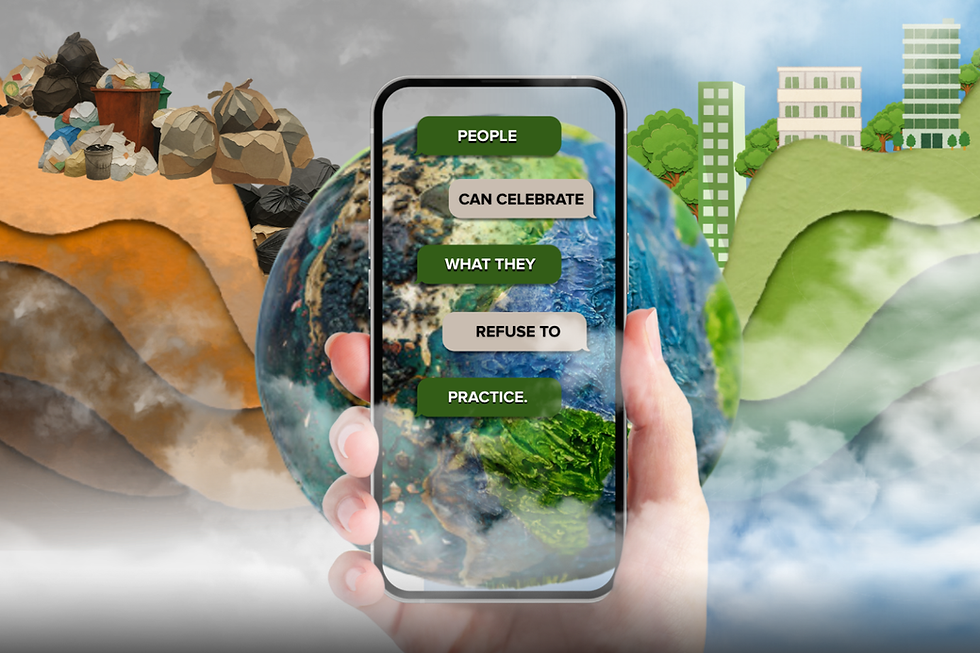
Proof that people can celebrate what they refuse to practice.
Garbage above the Clouds
On ordinary mornings, a familiar jingle echoes around the block, making everyone run around to retrieve their trash bags. Aboard the big truck are garbage collectors—the city’s cleanup crew. Dressed in uniforms dulled by years of labor, boots covered in mud, and gloves that have held more waste than people can imagine.
They pick up mountains of garbage, bags filled with spoiled leftovers, animal feces, plastic containers and cups, broken glass—and a lot of plastic sachets. According to the World Bank's 2021 report, Filipinos consume 163 million sachets every single day. Condiments, milk, coffee, soap, and shampoo sachets. Look around inside your home and notice how many sachets you keep and throw away each day.
Each year, the country generates around 2.7 million tons of plastic waste, and this continues to rise, with an estimated 20% ending up in the ocean. This is like dumping a full garbage truck into the sea every six minutes. In a 2023 study by EcoWaste, around 90% of the 12 million pieces of marine litter collected from the bay's coastline are plastics.
For a nation with more than 7,600 islands, this isn't just a trash problem. It is like a massive, man-made mountain of waste slowly rising out of water, threatening every coastline and ocean that hosts millions of marine life that Filipinos rely on for food and tourism.
What’s more, in a 2023 survey from Social Weather Stations (SWS), about 61% of families try to segregate their biodegradables at least “often,” but the remaining, around 39% to 40% either struggle to do it consistently or never engage in segregation at all. When it comes to disposal, while 64% rely on garbage trucks to collect their trash, nearly a third of the population still resorts to environmentally harmful practices such as burning their garbage (27%) or burying it on the ground (9%). A reminder of how many millions of Filipinos still lack the habit of using standardized waste systems.
Landfill Out of Stock
In the Philippines, schools and campuses are proud and consistent in placing biodegradable and non-biodegradable bins in hallways, as if labeling trash bins would automatically solve the problem. Students try to segregate, at least in the beginning, until they notice the same garbage truck that collects everything and mixes all the trash together.
Despite the enactment of Republic Act (RA) 9003 or the Ecological Solid Waste Management Act of 2000, which mandates segregation at the barangay level, some local government units (LGUs) have yet to strictly enforce the law. According to an official DENR Facebook post as of 2025, although more cities have “plans” on paper, there are only 373 sanitary landfills for the whole country. This means that over 900 cities and towns still do not have a proper place to put their garbage.
While the government says more than 21,000 barangays have access to Materials Recovery Facilities (MRFs), that is only about 50% of the country's 42,011 barangays. Although things are improving slightly, half of the country is still missing basic facilities required by the law that is now over 25 years old.
What We Throw Away Comes Back
Almost two weeks before Earth Day, a massive fire broke out at the Navotas Sanitary Landfill on April 10, burning mountains of garbage for three days before it was under control. It is a haunting reminder of how poorly managed waste can turn into a dangerous disaster.
Within the dump, there are millions of decomposing organic matter that naturally generates methane gas. Openly facing the scorching sun, the landfill acts like a giant fuel tank that can easily ignite and cause a fire to “rekindle” even after it seems extinguished.
This combustion, according to the Department of Health (DOH), released thick smoke filled with PM2.5 as it drifted across the nearby communities. These are very small dust particles only 2.5 microns in size. They are so tiny that when inhaled, they can bypass the body's natural filters and settle deep within the lungs. This forces residents to deal with polluted air that is toxic to breathe, especially for children, senior citizens, and individuals with respiratory problems.
Not only does it threaten public safety, but it also extends its impact beyond the environment. The massive amount of methane released, which is a greenhouse gas far more potent than carbon dioxide, accelerates global warming. What’s more, it produces black carbon or soot that lingers in the atmosphere, trapping heat and darkening the sky. Beyond the air, the toxic ash from the fire can seep into the soil or be washed by rain into nearby waterways like Manila Bay, poisoning marine life and contaminating the ecosystem long after the flames are extinguished.
The Navotas incident exposes the ugly truth that trash does not disappear once it’s thrown away—it only changes form, becoming smoke, toxins, and long-term damage.
A Habit Called Responsibility
As scientists continue to warn the world about rising global temperatures and stronger storms, Earth Day reaches a point where it no longer feels like a celebration and starts feeling like a warning. Because the planet does not need another slogan. It needs change.
A tree is not only a symbol on an Earth poster. It is a shade for a street vendor who sells ‘palamig’ under the sun. Clean rivers and lush mountains are not only for aesthetics. They are defenses against floods. Proper segregation is not only discipline. It is protection for communities living near the landfill.
Earth Day doesn't have to be perfect. It’s about becoming consistent.
The celebration of the planet is practiced not through speeches, but in habits such as saying no to plastic straws, bringing reusable utensils anywhere you go, unplugging chargers and appliances when not in use, reusing water, and taking a walk when it's a short distance.
Or throwing trash properly, even when nobody is watching. Calling out people who litter. Avoid sachets, and when possible, buy only refill packs or bigger containers. Stop overconsumption, buy less, buy long-lasting products, and repairment instead of replacement.
Inside the home, separate trash into biodegradable, non-biodegradable, and electronic waste.
Change begins in a habit we call ‘small.’
These small actions do not feel heroic, which is why they are overlooked and rarely celebrated. But the planet does not need heroes every April.
It needs ordinary people who are willing to be disciplined on ordinary days.
One day of green fever is not enough. Not when the Earth has to endure the other 364 days.
Article: Danica Fabonan
Graphics: Keren Hope De Leon

Comments