


Step by Step, Faith Moves: Walking with the Black Nazarene

Every January 9, the streets of Quiapo transform into a river of faith. Millions of barefoot devotees march alongside the Black Nazarene, a centuries-old statue of Christ carrying the cross, moving slowly through Manila’s streets in a ritual known as the Traslación—a sea of fervor that spreads through the city.
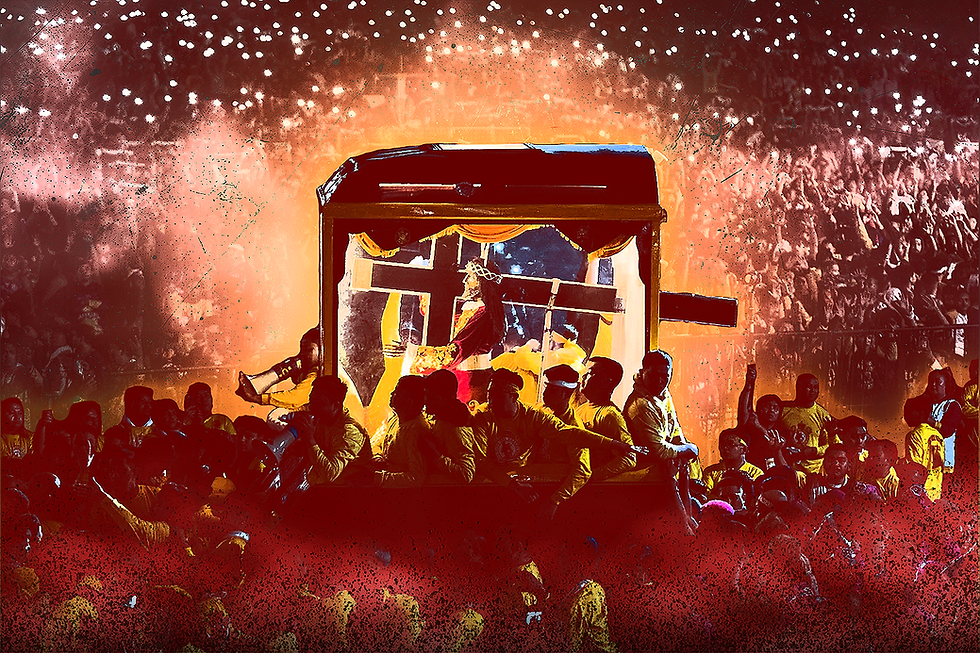
The Black Nazarene wasn’t originally from Manila; it was carved in Mexico and brought to the Philippines in 1606. Over time, it has survived fires, earthquakes, wars, and the chaotic collisions of history. Despite all of this, the image remains a symbol of resilience. Filipinos today still see in this statue not just the wounds of Christ, but a reflection of their own struggles. In these marks, they find their own strength.
The Traslación commemorates the statue’s journey to its home—the Minor Basilica of the Black Nazarene, more famously known as the Quiapo Church, which officially enshrined the image in 1787. What began as a simple transfer has become one of the world’s largest Catholic processions. Each year, millions gather, not only to celebrate but to fulfill vows, seek healing, and whisper prayers while gripping the ropes that guide the andas (the carriage carrying the sacred image) through the streets. Each pull of the rope is an act of devotion.
Last year, the 2025 Traslacion drew over 8 million devotees, walking for nearly 21 hours, a river of faith that seemed endless—its course stretching far beyond the horizon. This year, during the first Sunday of Nazareno Week 2026, around 8,000 devotees have already gathered, preparing for the flood of worshippers that will surge through the streets on January 9. Step by step, chant by chant: "Viva Poong Hesus Nazareno! Viva!" The chant rises above rooftops, over walls, through every street, pulsing in the chests of all present—a heartbeat of the city itself.
And to truly understand it, you have to experience it with all five senses.
Sight: A Sea of Maroon
From the first step, your eyes are overwhelmed.
Maroon stretches endlessly, a living river of shirts, towels, and scarves flowing through the streets, weaving between buildings and street vendors, winding into every alley and corner. Faces glisten with sweat and tears, eyes wide with hope, reverence, and anticipation. Children ride on shoulders, elders lean on strangers, and the Black Nazarene glimmers under the sun, its dark, serene face unbothered by the surge of humanity around it. Hands clutch ropes, grip towels, brush against strangers—each movement deliberate, each step a prayer. Step by step, the river moves.
Bobby Violeta, a devotee since 2000, grins through sweat and exhaustion. “First time ko sa Traslacion noong year 2000 pero nagsisimba na ako noon sa Quiapo way back 1976, tapos tuloy-tuloy na yun until now, habang buhay siguro ako… This is my legacy.”
Every glance and every hand brushing against yours tells a story, centuries in the making.
Sound: The Chant That Moves Millions
Then comes the sound.
“Viva Poong Hesus Nazareno! Viva!” rises, falls, crashes, and rises again like waves over the crowd, echoing off buildings, rattling chests, vibrating through every bone. Children cry out, elders murmur prayers, and the steady thump of bare feet on asphalt becomes percussion for the city itself. Step by step, voice by voice, the chant becomes something larger than any individual, larger than the streets, larger than Manila itself.
One voice becomes thousands, thousands become millions, and the sound becomes devotion made audible, echoing centuries of tradition, from Mexico to Quiapo.
Touch: The Weight of Faith
The rope is rough against your calloused palms, vibrating with the sway of the andas. Shoulders press, arms bump, a child clings to your wrist, strangers brush past yet remain tethered by shared intent. Touch here is not accidental; it is faith made physical, devotion expressed in every contact, every grip, every pull. Step by step, brush by brush, the crowd moves as one, connected in an unspoken rhythm.
Violeta shares, “Parang alon yung mga tao, halos magkapalit na yung mga mukha. Mahirap. ‘Yung panahon pa namin nila Noli de Castro, nagyayapak yan, walang sapatos o tsinelas. Nabubog na yan si Noli sa siksikan pero wala, routine na nila yan sa Traslacion.”
Every brush, every clasp, every grip is a prayer in motion, linking thousands of hearts, each step a story of endurance and devotion.
Smell: Incense, Sweat, and Candle Smoke
The air is thick with layered scents. Coils of incense curl above heads, burning sweet and sharp. Candle wax softens the edges of the city’s morning haze. But it's not just the sacred smells that fill the air; it’s also the very essence of the crowd. Sweat, heavy and salty, mingles with the dust kicked up by millions of feet. The aroma of tired, human bodies pushes through the thick cloud of incense and candle smoke. It's raw, yet part of the sacrifice, part of the devotion. Step by step, breath by breath, the smells merge, tangible proof of devotion pressed into every inch of the streets.
The fragrance clings to hair, skin, and clothing, a sensory imprint of every prayer offered. The aroma of faith is intoxicating, overwhelming, unforgettable.
Taste: Dust and Prayer
Dust coats your tongue. Lips dry from shouting, throat raw from joining the river of voices. Every inhalation tastes of incense, sweat, and the city itself, every exhale carries your prayer into the sea of devotees. Step by step, shout by shout, your voice joins millions of others, tasting devotion in its purest form, bitter and sweet, alive.
Violeta takes a deep breath, “After sa Traslacion, nadadagdagan ‘yung faith mo. Katulad ng cellphone, ang tao ay nalolowbatt din. Hindi lang sa financial problems, domestic problems, kasama na ang spiritual problems. Kaya ayun, para akong nagcha-charge kapag na-attend ako ng Traslacion. Iba, iba talaga ‘yung feeling.”
Every taste, every breath, every chant becomes a memory, a mark of shared faith.
At the End of the Day
By the time the andas returns to Quiapo Church, feet blistered, voices hoarse, and eyes red, the air still hums with devotion. Candles flicker, incense lingers, dust clings, and the city exhales. Step by step, you realize something: you’ll come back next year. And the year after that.
Step by step, year by year, the river flows again, unstoppable, eternal. The chant rises, softer now, but still steady: “Viva Poong Hesus Nazareno! Viva!” Even when the streets empty, even when bodies part, faith remains. It pulses in every footstep, every heartbeat, every whispered prayer.
And you know, in the quiet after the crowd fades, that devotion is never-ending, ever-moving, always waiting for you to return.
Article: Xyra Caryl Zaleta
Graphics: Jan Mike Cabangin

Comments