


A Carnival of Accountability

Over the last couple of months, the flood control saga, meant to protect entire communities from displacement or death, has finally moved from headlines to handcuffs. Sarah Discaya, tied to ghost projects in Davao Occidental, has been detained in Cebu since last December, facing graft and malversation charges for a P96.5-million “ghost” flood control project in Davao Occidental currently under litigation in a court in Cebu. Multiple DPWH executives are under arrest. Warrants have been issued for ex-Rep. Zaldy Co and 17 others. Former Senator Bong Revilla surrendered last month over the non-existent Pandi, Bulacan flood project.

High-Ranking Government Officials from DPWH Secretary Vince Dizon to President Bongbong Marcos have described these arrests as merely the opening act in a broader push for accountability, promising more charges and detentions as proof that no one is above the law. It is a familiar assurance, delivered in familiar tones, at a familiar moment in the cycle. The language of resolve has been used before. Following previous scandals, disasters, and losses, each time it arrived with the same promise of rupture, it only faded into continuity. Once again, accountability is promised as the next act, always just beyond the spotlight, while the crowd is asked to believe that this show will end differently.
Yet, the pattern is painfully familiar, repeated across republics, administrations, and generations. Outrage flares. Arrests are made. Demonstrations swell. Headlines dominate the news cycle. Convictions lag, reforms stall, and the system resets. The September 21 ‘Baha sa Luneta’ protest drew massive crowds demanding justice for billions allegedly siphoned from public infrastructure. Months later, the structure of accountability is still leaky. Ghost projects remain, defenses fail, billions have vanished, and the architects of the system have slipped back into their offices and chairs of power.
This is not a new performance. Long before the flood control debacle, Philippine politics perfected the art of spectacle. From the Golden Arinola scandal of the 1940’s, which forced senators into hearings on whether an arinola was made of gold. To PEA-Amari, where an undervalued land deal led to the exposure of “the grandmother of all scams”. To the Fertilizer Fund Scandal of the 2000’s, where Ill-Gotten wealth meant to finance farmers, allegedly went to the reelection campaign of President Arroyo. To the PDAF or Pork Barrel Scam, a multibillion‑peso controversy that revealed how lump‑sum funds meant for local services were channeled into fake NGOs controlled by intermediaries, with senators and representatives implicated yet rarely held to account in ways that change the incentives of the powerful.
Across decades, the pattern repeats: committees convene, hearings are televised, interim reports are drafted, and the public is appeased with promises of justice. The audience is given the comforting ritual of accountability, yet the knockout punch never arrives. Each display becomes a show, outrage consumed like cotton candy: sweet in the moment, and dissolving before it can alter the structures that produce corruption in the first place.
The theft here is not only of billions in pesos, it is the theft of trust itself. Every incomplete investigation, every half-hearted arrest, every report that vanishes into a drawer chips away at the belief that law can safeguard ordinary citizens. Accountability becomes a performance, outrage becomes a commodity, and civic energy is drained into spectacles rather than solutions. It is not that protest lacks power, but that heat is repeatedly funneled into committees, hearings, and procedural dead ends, into spaces designed to absorb public anger without allowing it to disrupt the structures that produced the abuse in the first place
.
The flood control debacle is the latest act in a familiar choreography. Arrests, asset freezes, press conferences, and temporary resignations are rolled out to reassure the public without ever threatening those who hold real leverage. The problem is not a handful of rogue personalities, but institutional roles, those who design contracts, control allocations, and shield networks, regardless of who temporarily occupies the position. Power survives by rotation. Politicians deny wrongdoing, rebrand themselves, resurface in new posts, and quietly rewrite the rules by which they are judged. In this arrangement, those who promise accountability are often the same actors tasked with preserving the structures that make corruption durable. They perform concern on television and social media, clasp hands with activists, and speak the language of reform, while the underlying mechanisms remain untouched. The public is allowed its moment of visibility, before the lights dim, the system resets, and the projects meant to protect communities continue to fail.
And while the audience claps for the spectacle, the architects of the system slip through the exits. They redesign contracts, rotate positions, and spin narratives until the scandal fades from headlines. The people are left holding the empty confetti of outrage, while the carnival rolls on, fueled by unpunished power and endless repetition. Every new scandal is a new ride, thrilling for a moment, yet returning its passengers to the same old starting point. Trust erodes, hope is tested, and the stage remains firmly in the hands of those who engineered the show from the beginning.
A nation is not measured by the number of investigations it announces or the speeches it delivers against wrongdoing. It is measured by whether wrongdoing actually ends. When scandals are met with hearings instead of handcuffs, when graft-ridden contracts are debated in committees instead of dismantled, what emerges is not justice but a theater of absolution. Applause, viral posts, and trending hashtags become substitutes for consequence. The audience leaves momentarily satisfied, while the show continues and those responsible return to their offices, their contracts, and their unchecked influence.
Yet the anger persists. Outrage survives, not as a prophecy, but as refusal. The insistence that corruption and cowardice are not permanent features of public life has not been extinguished, even as it is repeatedly tested. This spectacle may endure for years, even decades, but no system sustained entirely by performance is immune to collapse. Until that reckoning arrives, the performance continues, the lights remain bright, and accountability remains staged rather than enforced—a reminder that justice, delayed and deferred, is not absent by accident, but withheld by design.
Article: Kyan Miguel San Agustin
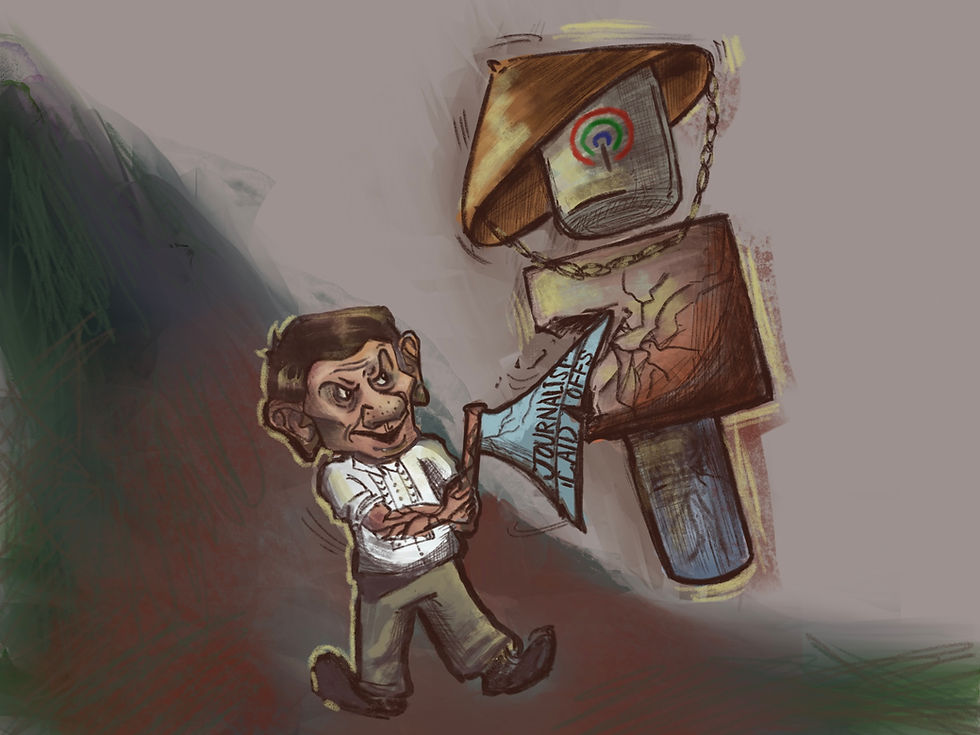
Cartoon: Sherlyn Zabate

Comments